
The first drawing is simple enough to look unfinished.
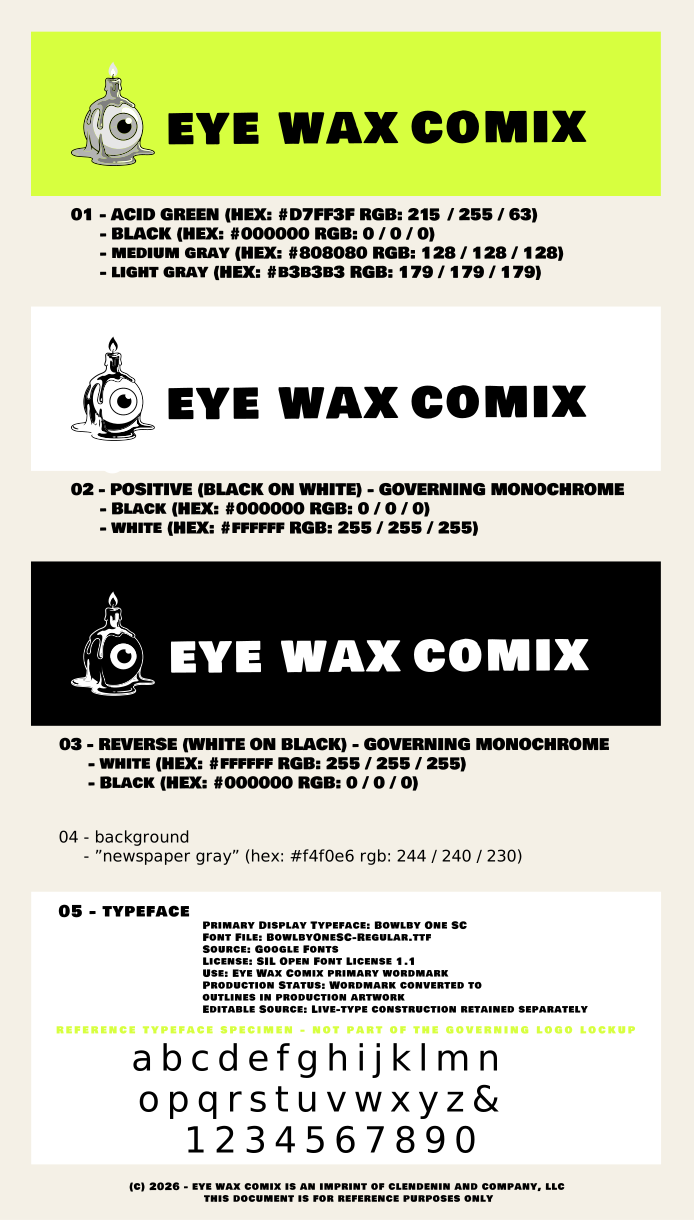
A pale figure rises through a field of graphite. The head tips upward. The neck stretches farther than anatomy asks it to. The arms hang loose. The hands barely resolve. A dark fan of marks pushes out from the head and shoulder while the rest of the page stays open, rough, and searching.
That drawing is Plate 01.
Johann made it by hand. It became the source for a series of experiments inside Eye Wax and ACORN because it carried more information than its level of finish suggested.
What has to survive for this to remain the same drawing?
The source carries its own instructions
Plate 01 has several obvious features: the upward tilt of the head, the long neck, the pale central body, the hanging arms, and the dark field radiating away from the figure.
It also carries quieter information. The face is unresolved. The hands stay simple. The body is only partly modeled. The graphite records pressure changes and hesitation. The dark marks behind the figure behave like force and direction as much as hair. The surrounding space supports the figure while remaining atmospheric.
Those qualities keep the drawing active. The image is still deciding what it is. That state of decision became part of the source.
A disciplined pass
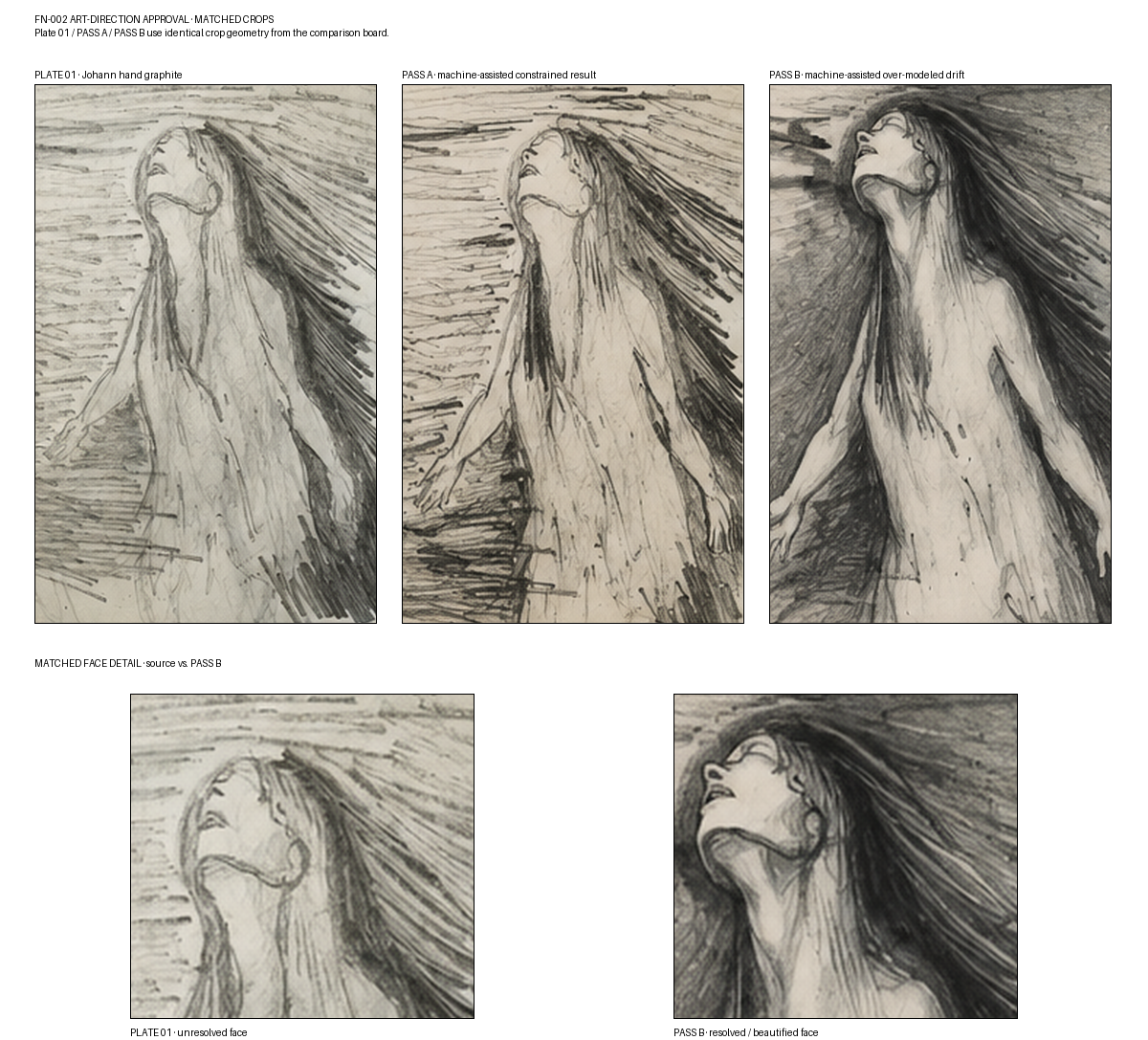
PASS A preserves the upward head tilt, the long neck, the hanging arms, the pale central mass, and the directional graphite field. It stays close to the source's proportions and keeps the figure visually dominant.
The result is cleaner, while the important relationships remain visible. That gave us a useful lesson: fidelity lives heavily in gesture, silhouette, value structure, proportion, and omission.
ACORN holds the source beside the variation, records what Johann recognizes as essential, and carries those observations into the next experiment.
What polish changes
PASS B is more polished. The face becomes attractive and legible. The neck and shoulders settle into more conventional anatomy. Hair becomes hair. The body acquires smoother volume. The rendering reads as confident and finished.
The source drawing had been carrying uncertainty as information. PASS B converts much of that uncertainty into answers. That distinction changed the way we evaluate visual development.
Graphite texture, sketch marks, and an unfinished appearance can coexist with deeper structural drift. Correspondence asks a more useful question: what did this pass keep, what did it invent, and what did the invention do to the work?
What drift teaches
Eye Wax keeps unadmitted material in the working record. Some results reveal generic rendering. Some add confident answers where the source stayed open. Some preserve a useful fragment even when the whole image drifts.
Each pass can reveal a weak constraint. Repeated drift can expose something the creator knows intuitively and has never had to name. A convincing departure can make the controlling source relationship easier to see.
The tool enters a longer process
Eye Wax works across hand drawing, stylus input, scanning, tracing, vector construction, typography, color systems, Adobe tools, procedural transformation, computational comparison, dimensional studies, and model-assisted visual development.
A graphite drawing can establish gesture. A vector path can clarify shape. A color study can test hierarchy. A dimensional model can expose proportion. A generated variation can reveal drift. A physical maquette can reveal weight. A stop-action test can reveal timing. A CGI turntable can reveal spatial relationships.
One representation teaches the next. The source remains attributable. The changes remain visible. Johann decides what advances. ACORN keeps that continuity legible across the toolchain.
Open Lab note
This Field Note is the first ACORN Open Lab evidence family. The Open Lab keeps the source, selected experiments, drift findings, creator dispositions, and revised constraints together so readers can follow how the work changes.
Plate 01 is the source. PASS A shows a strong constrained correspondence. PASS B shows how polish can redirect the image. The next passes begin with what those three images taught us.